
AI Search Visibility Metrics & KPIs
AI Search Visibility metrics measure whether a brand is mentioned, cited, described accurately and included in commercially relevant AI-generated answers across a defined set of prompts.
This guide explains the core metrics, formulas, testing method, interpretation limits and the role of Ranknizer’s SETC framework in diagnosing the conditions behind weak or inconsistent visibility.
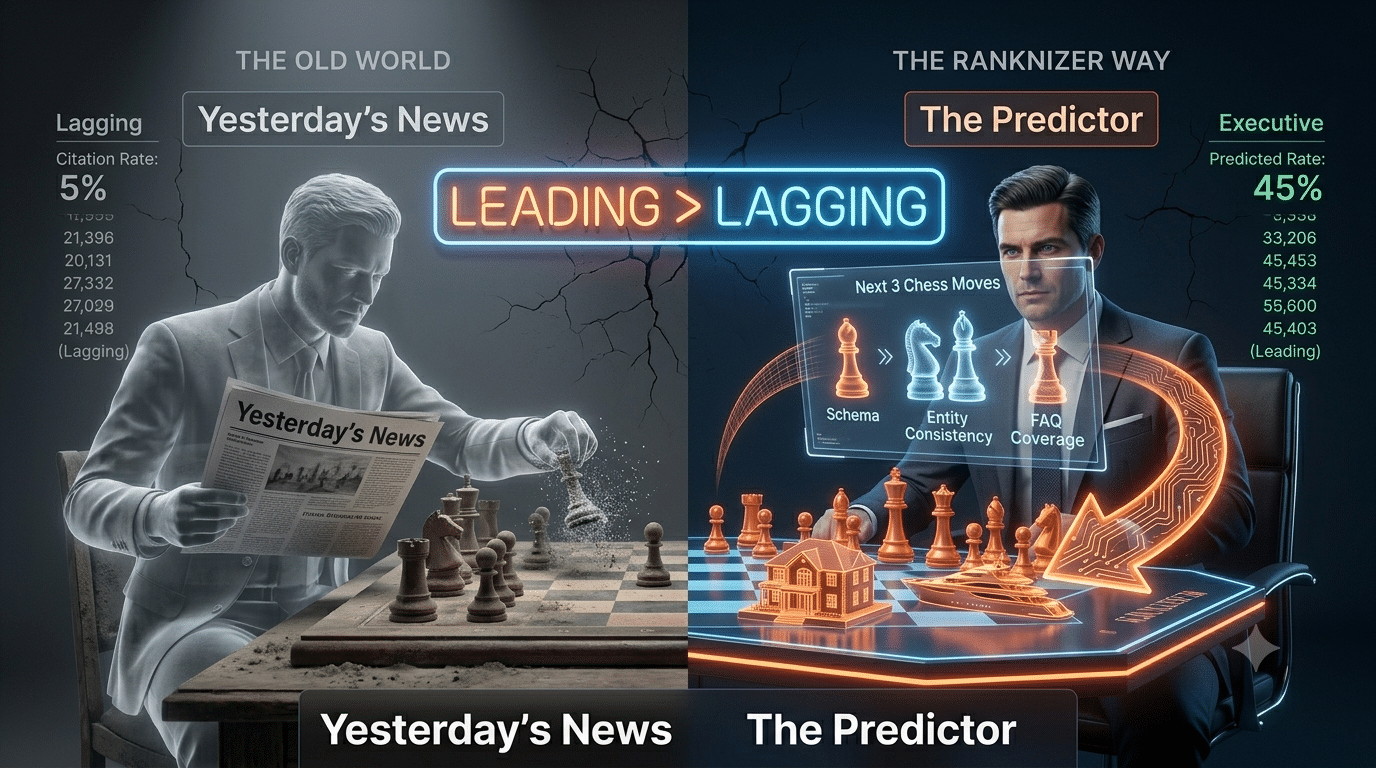
What Are AI Search Visibility Metrics?
AI Search Visibility metrics are measurements used to evaluate how often, how accurately and in what context a business appears inside AI-generated answers.
A reliable measurement system uses a defined prompt set, records results separately by platform and compares those results with a baseline or competitor set. It does not rely on a single blended score.
The most useful metrics include mention rate, citation rate, prompt coverage, answer accuracy, competitor share, platform consistency and commercial prompt visibility.
Why Traditional SEO Metrics Are Not Enough
Search rankings, impressions, clicks and organic traffic remain important, but they do not show whether a business was named or cited inside an AI answer.
A user can receive a complete answer without visiting the business website. In that case, traditional analytics may record no click even though the brand was visible and may have influenced the user’s next decision.
SEO outcome
A page receives visibility in search results and may earn impressions, clicks and traffic.
AI visibility outcome
A brand or source appears inside a generated answer, with or without a click to the website.
Important distinction: search performance can support AI visibility, but rankings and AI mentions are not interchangeable measurements.
The Main AI Search Visibility KPIs
Each KPI should have a clear definition, a consistent denominator and a practical interpretation.
Mention Rate
Prompts that mention the brand ÷ total tested prompts × 100Shows how often the business is named across the tested prompt set.
Citation Rate
Answers citing a business page or source ÷ total tested answers × 100Shows how often the website or an associated source is referenced as supporting information.
Prompt Coverage
Prompts with useful visibility ÷ total tested prompts × 100Measures how broadly the business appears across the questions that matter.
Answer Accuracy
Accurate brand descriptions ÷ total brand descriptions reviewed × 100Measures whether services, audience, location and positioning are represented correctly.
Competitor Share
Brand appearances ÷ all tracked brand appearances × 100Compares the business with selected competitors across the same prompts.
Platform Consistency
Platforms producing aligned brand information ÷ platforms tested × 100Shows whether visibility and brand descriptions remain similar across platforms.
Commercial Prompt Visibility
Commercial prompts with useful visibility ÷ total commercial prompts × 100Measures whether the business appears for service, comparison and recommendation questions.
What Each KPI Tells You
| KPI | What It Measures | What a Weak Result May Indicate | What to Review Next |
|---|---|---|---|
| Mention rate | How often the brand is named. | Weak category association or stronger competitor recognition. | Entity clarity, topical coverage and commercial relevance. |
| Citation rate | How often a page or source is referenced. | Limited source usefulness, weak evidence or insufficiently specific content. | Evidence, page structure, source quality and citation readiness. |
| Prompt coverage | How broadly the business appears across the test set. | Narrow content coverage or poor alignment with buyer questions. | Page ownership, supporting content and internal linking. |
| Answer accuracy | Whether the business is described correctly. | Conflicting profiles, outdated information or unclear positioning. | Website facts, official profiles and entity consistency. |
| Competitor share | Relative presence against selected competitors. | Competitors may have stronger evidence, clearer positioning or deeper coverage. | Competitive gaps by prompt, page and source type. |
| Platform consistency | Whether results align across AI systems. | Uneven source access, platform differences or inconsistent external information. | Platform-specific results and source references. |
| Commercial prompt visibility | Presence in high-intent answers. | The site may be visible informationally but disconnected from buying intent. | Services, comparison pages, use cases and commercial page ownership. |
Outcome Metrics vs Diagnostic Signals
The metrics above report what appeared in AI answers. Diagnostic signals help explain why those outcomes may be weak.
Outcome metrics
Diagnostic signals
SETC diagnoses the conditions behind visibility. The KPI set measures the observable outcomes. A diagnostic signal should not be described as a guaranteed predictor of citation.
How SETC Supports KPI Analysis
Ranknizer uses SETC to organise the investigation after weak or inconsistent visibility has been identified.
The framework does not reproduce the private ranking systems of AI platforms. It provides a practical method for reviewing machine-readable structure, entity clarity, topic coverage and evidence.
Structured Data Quality
Checks whether structured information accurately represents the organisation, founder, services and page relationships.
Entity Recognition
Checks whether the business is consistently identified by name, category, location, audience and expertise.
Topical Authority Signals
Checks whether the site provides connected and sufficiently deep coverage around key topics and buyer questions.
Citation Readiness
Checks whether important information and claims are specific, supportable and suitable for reference.
How to Build a Useful Prompt Set
The quality of the measurement depends on the quality of the prompts. A prompt set should represent real discovery and buying behaviour rather than only direct brand-name searches.
Brand prompts
Test whether the system recognises and describes the business accurately.
Category prompts
Test whether the business appears when users ask about the broader service category.
Comparison prompts
Test whether the brand is considered alongside relevant competitors or alternatives.
Commercial prompts
Test high-intent questions involving recommendations, providers, locations and use cases.
Prompt wording, location, account state, model version and retrieval behaviour can affect the answer. Keep the test conditions as consistent as practical and document meaningful changes.
A Practical AI Visibility Measurement Process
Define the objective
Decide whether the test is measuring brand recognition, category discovery, commercial visibility, citations or competitor share.
Create the prompt set
Use customer questions, Search Console data, sales conversations and category research to build a relevant list.
Test platforms separately
Record results by platform rather than hiding differences inside one blended score.
Record the answer consistently
Capture mentions, citations, accuracy, competitor appearances and the commercial relevance of the result.
Diagnose the gaps
Use SETC, page ownership and source review to investigate why important prompts produced weak results.
Retest against the baseline
Use the same core prompt set when comparing later results, while documenting platform or model changes.
Limitations of AI Visibility Measurement
AI visibility data is useful, but it should not be treated as perfectly stable or universally comparable.
How to Start Measuring Your AI Visibility
Ranknizer provides free snapshots for initial checks and a paid manual audit for deeper prompt-based diagnosis.
AI Search Visibility Score
A free website-readiness snapshot covering structure, entity clarity, topical coverage and citation readiness.
AI Brand Visibility Checker
A free brand-recognition snapshot showing how ChatGPT identifies and describes the business.
$99 Manual AI Visibility Audit
Includes 10 commercial prompts, ChatGPT, Google AI Overviews, two competitors, a PDF and spreadsheet, delivered in three business days.
AI Search Visibility Services
Compare free checks, the manual audit, the $150 consultation and custom implementation.
If you measure visibility for a consulting practice, I explain the relevant prompt types and evidence in my AI Search Visibility guide for consultants.
AI Search Visibility Metrics FAQs
What are AI Search Visibility metrics and KPIs?
AI Search Visibility metrics and KPIs measure whether a brand is mentioned, cited, described accurately and included in relevant AI-generated answers across a defined prompt set.
What is citation rate?
Citation rate is the percentage of tested AI answers that cite a business page or associated source. It is calculated by dividing cited answers by total tested answers and multiplying by 100.
What is mention rate?
Mention rate is the percentage of tested prompts where the business is named inside the AI-generated answer.
What is the difference between an outcome metric and a diagnostic signal?
An outcome metric records what appeared in AI answers, such as a mention or citation. A diagnostic signal helps investigate why the result may be weak, such as poor entity consistency, limited topic coverage or weak citation readiness.
Do Google rankings predict AI citations?
Search rankings and AI citations are related visibility signals, but one does not reliably prove the other. They should be measured separately.
What is a realistic AI visibility benchmark?
There is no universal benchmark that applies fairly across industries, brand maturity levels, platforms and prompt sets. The most reliable starting point is the business’s own documented baseline and a relevant competitor comparison.
How often should AI visibility be tested?
Testing frequency should match the business objective, content-change cycle and available resources. The most important requirement is to use a consistent core prompt set and document major platform or model changes.
Can one AI visibility score represent every platform?
A blended score can provide a summary, but it may hide important differences between platforms. Detailed analysis should preserve platform-level results.
Does improving SETC guarantee higher citation rates?
No. SETC helps diagnose and improve conditions that may support visibility, but AI platforms control their own outputs and no framework can guarantee mentions or citations.
Where should a business start?
Start by defining the objective and prompt set. Use a free snapshot for an initial website or brand check, or a manual audit when deeper prompt testing and competitor comparison are required.
Measure Outcomes, Then Diagnose the Cause
A useful AI visibility report does more than produce one score. It shows where the business appears, how accurately it is represented, which competitors are present and which website or entity signals require further investigation.