
ChatGPT Wallet is OpenAI’s payment feature for purchases a user reviews and approves. After approval, it uses a tokenized payment credential so the user’s actual card details are not shared with the agent or merchant.
ChatGPT agent access means a verified cloud browser can visit a business website to complete a user-directed task. OpenAI’s ChatGPT Wallet launch came with guidance for helping businesses make that journey work: keep business and product information accurate, verify signed browser requests, make intended website tasks usable, and coordinate with payment and fraud providers. This raises a practical question: after a business is discovered or recommended, can its agent complete the task? OpenAI has not said that allowing these browser visits improves ChatGPT Search rankings or citations.
Research note · Checked November 16, 2026
ChatGPT agent access and AI-search visibility describe different outcomes. A company can appear in an AI answer while its website blocks the browser agent. A website can allow verified agent access and still never be recommended. Both are worth understanding, but they should be measured separately.
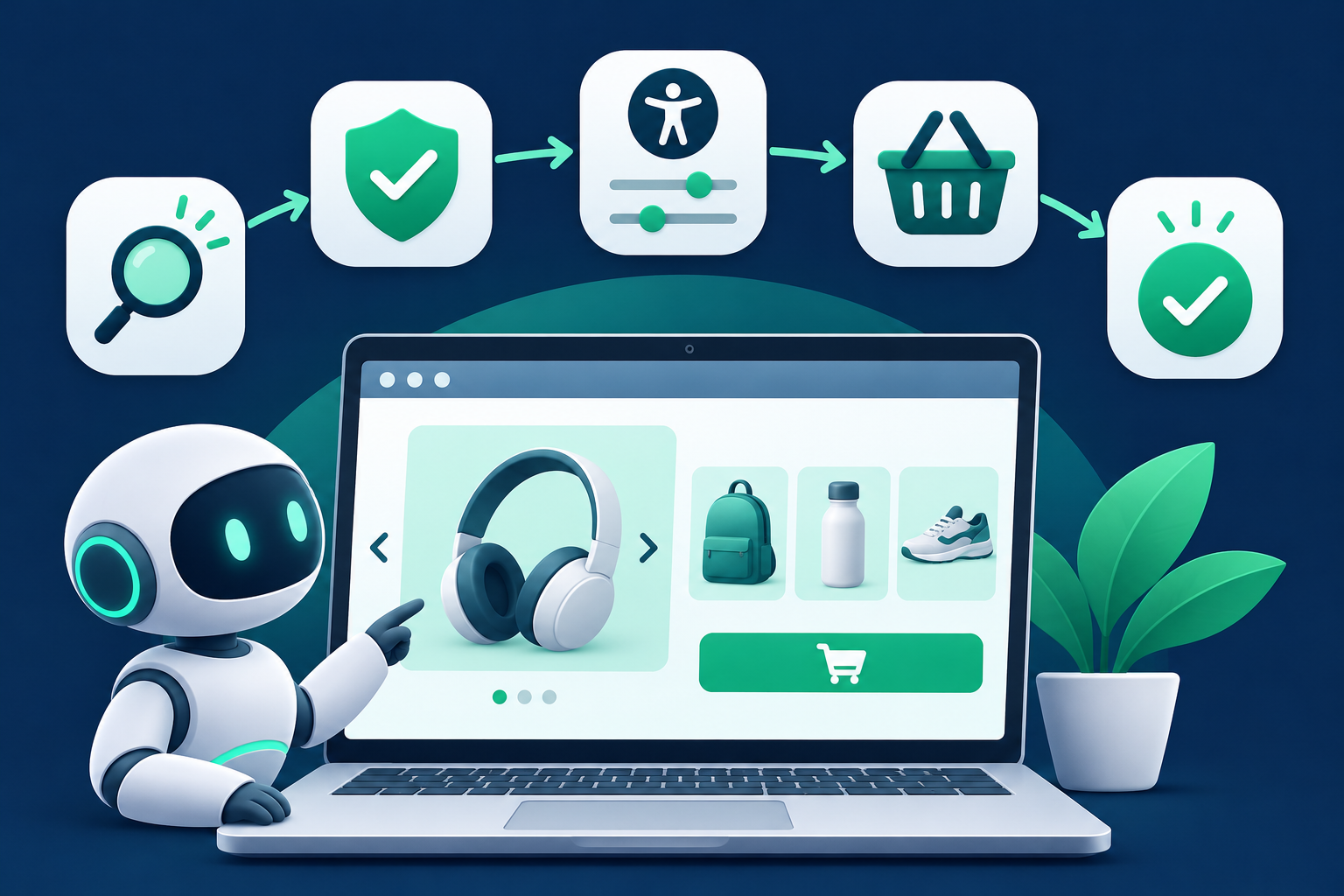
What ChatGPT Wallet means for agent access
On November 13, 2026, OpenAI introduced ChatGPT Wallet and published business guidance alongside it. The guidance covers accurate business and product information, access for verified ChatGPT cloud-browser requests, payment and risk-system compatibility, and optional ways to expose structured actions through plugins or WebMCP. OpenAI describes the broader activity as early-stage, and says Wallet is rolling out gradually to eligible users in the United States.
ChatGPT Wallet is designed to let a user review and approve a purchase before the agent continues checkout. After approval, a payment network provides a tokenized credential in place of the user’s actual card details. That credential is intended to work with existing checkout flows, but OpenAI notes that payment and fraud systems may still flag legitimate agent-assisted purchases. A successful approval also does not, by itself, prove that the merchant created an order.
At launch, OpenAI said Wallet would initially be available to ChatGPT Pro users aged 18 or older in the United States with eligible US-issued cards. Its help page still describes a gradual rollout and says even eligible users may not yet have access. Recheck the current Wallet availability and purchase guidance before making implementation plans.
The six stages of website readiness
A useful way to plan is to separate the journey into stages. Each can fail independently, and each calls for a different check.
| Stage | What happens | What to check |
|---|---|---|
| 1. Discovery | A person or AI system encounters your business, products or services through public information, business details or product data. | Are your identity, services, prices, policies and availability accurate and consistent? |
| 2. Search retrieval | A search system retrieves pages to help answer a query. | Can relevant search crawlers access the pages you intend to make discoverable? |
| 3. Verified browser access | A cloud browser visits pages for a user-directed task; signed requests can be verified with Web Bot Auth. | Does your CDN or firewall recognize verified requests without weakening unrelated controls? |
| 4. Website interaction | The browser reads pages and uses controls, forms or navigation. Optional structured tools can support specific actions. | Can the intended workflow be completed and recovered from errors? |
| 5. Payment and risk review | The user may approve a purchase; payment, issuer and fraud systems evaluate it. | Do existing providers handle the credential and distinguish legitimate activity from risk? |
| 6. Merchant confirmation | The merchant system creates the order or records the lead and returns a confirmation. | Is there a reliable final state that confirms what actually happened? |
The sequence can be summarized as find information → retrieve a page → verify access → complete a permitted task → authorize payment if needed → confirm the merchant outcome. A failure near the end does not necessarily mean discovery or search visibility failed.
How Web Bot Auth verifies ChatGPT agent access
OpenAI’s cloud browser can visit a website on a user’s behalf to read pages, click controls and interact with a site. A CDN, firewall or other edge service may challenge or block this traffic under normal security rules. OpenAI’s guidance explains how infrastructure can identify certain signed ChatGPT browser requests using Web Bot Auth.
Web Bot Auth uses the HTTP Message Signatures standard, RFC 9421. OpenAI’s documented signed requests include the Signature, Signature-Input and Signature-Agent: "https://chatgpt.com" headers. A site’s edge service can retrieve OpenAI’s published verification keys and validate the signature. A claimed user-agent name or an unsigned header is not equivalent to signature verification.
OpenAI says Akamai, Cloudflare, HUMAN and Vercel can verify supported requests automatically. The configuration steps and dashboard labels are provider-specific and can change, so use the current OpenAI agent-access instructions and your provider’s current documentation. If custom verification is needed, follow the signature-validation process before creating an exception.
ChatGPT Agent access is not OAI-SearchBot access
This is the distinction website owners should keep clearest. OpenAI describes signed cloud-browser visits as traffic that acts on behalf of a user. It explicitly says this browser guidance is separate from its web crawlers, including OAI-SearchBot, which is associated with search.
As a result, allowing a verified browser visit does not establish that a search crawler can fetch your pages, that a page is eligible for retrieval, or that it will be cited or ranked. Likewise, rules for OAI-SearchBot do not by themselves tell you whether a browser can complete a form or proceed through checkout. Check and log the two kinds of access independently. Ranknizer’s guide to AI training, search and crawler controls covers related distinctions.
Do you need a product feed, plugin or WebMCP?
No, not for basic browser access. OpenAI says a product feed or plugin is not required for the cloud browser to navigate a website. These mechanisms have different roles:
- Public pages explain products, services, terms and the paths a customer can take.
- Product feeds provide structured information such as product details, price and availability to support discovery. A feed does not guarantee that a product will be recommended or included.
- Plugins or other structured tools can expose defined actions, such as checking availability or managing a cart, through a service connection.
- WebMCP tools are another way sites may expose structured actions. OpenAI presents them as an option, not a requirement for ordinary browser access.
Structured actions may be useful when a workflow depends on live inventory, appointment slots, exact quotes or several fragile steps. They also introduce design, security and maintenance work. Start from the customer task and its failure rate; do not add an integration solely on the assumption that it boosts organic discovery.
ChatGPT agent access: a practical website-readiness checklist
1. Make business and offer information accurate
- Keep your business name, location, service area and contact details consistent across important pages.
- State what you sell or do, who it is for, relevant conditions, policies and the next step.
- For products, keep identifiers, price, stock and delivery information aligned across the product page, feed and checkout.
- For bookings, reservations or quotes, identify which details are live and how often they update.
- Assign an owner to time-sensitive information. Stale availability or contradictory prices can make a technically accessible site unusable.
2. Review CDN, firewall and bot-management behavior
- Ask your security or hosting team whether signed ChatGPT cloud-browser requests are visible in logs and how they are currently treated.
- Confirm that any exception is based on verified signatures or your provider’s verified-bot mechanism, not on a spoofable label.
- Check which pages and assets are challenged, blocked or rate-limited, including scripts needed for the task.
- Keep account authentication, authorization, rate limits, abuse monitoring and sensitive-route restrictions in place.
- Track browser-agent policy separately from crawler policy. A verified agent is still subject to your site’s permissions and the user’s authorization.
3. Test the intended interaction
- Check whether key information is present and readable on the page, including product options, service terms and availability.
- Test navigation, filters, forms, validation messages, consent prompts, session handling and recovery from errors.
- Look for JavaScript rendering problems, CAPTCHA loops, unlabeled controls, inaccessible buttons, modal dialogs and third-party scripts that interrupt the flow.
- Decide which actions can be public, which require sign-in, which need an explicit human confirmation, and which should stay unavailable.
- For lead generation, test with a staging form and a clearly marked test submission. For bookings or ecommerce, use a staging environment and stop before any live payment.
4. Coordinate with payment, fraud and order teams
- Ask your payment service provider and fraud vendor how they evaluate legitimate purchases completed through an agent.
- Confirm how tokenized credentials interact with authorization, review, cancellation, refund and fulfillment processes.
- Record payment authorization, order creation, cancellation and fulfillment as different outcomes.
- Make the merchant’s final order or lead confirmation clear. If the confirmation is missing or ambiguous, neither the user nor the agent can safely assume the task succeeded.
How to test ChatGPT agent access safely
To assess ChatGPT agent access, measure a defined task rather than only checking whether the homepage returns HTTP 200. This protocol is a suggested operational method; it is not an OpenAI-certified benchmark.
Define the task and success before testing
Choose one representative workflow: find a specific product and report its current price; locate an appointment slot; submit a test consultation request; or add an item to a cart and reach the checkout review screen. Define what counts as accurate information, which steps must be completed, where the test must stop, and what confirmation counts as success.
Compare access conditions
- Run the workflow with the default security configuration.
- Run it with verified ChatGPT browser requests allowed under a narrow, documented policy.
- Send unsigned agent-like requests and confirm they do not receive the verified-agent exception.
- Confirm that sensitive routes remain protected even when a verified browser request is allowed.
- Run the same task manually in a human browser as a usability baseline.
Three attempts per condition can serve as an initial smoke test, but the sample is too small for a confident performance estimate. Repeat tests before making broader operational claims, and record the site version, access rule, task, date and number of attempts.
Record task outcomes and failure causes
- Signature verification result and the access policy applied.
- Pages and assets blocked, challenged or rate-limited.
- Whether product, service, price and availability information was extracted correctly.
- Steps reached, steps failed and the reason for each failure.
- JavaScript, CAPTCHA, consent, session, form validation and recovery behavior.
- Whether checkout review or a test form confirmation was reached; do not complete a live test payment.
- Completion time, date, run count and the exact success definition.
You can summarize results with a locally defined Agentic Task Completion Rate (ATCR):
Successful attempts at the predefined workflow ÷ all valid workflow attempts × 100
Report the rate by task, access condition, agent identity, date and run count, alongside failure categories. ATCR is a proposed operational metric for this article, not an OpenAI metric or an established industry standard. A single percentage without the task definition and failure breakdown is difficult to interpret.
Measure ChatGPT agent access separately from AI search visibility
| Search visibility measures | Agent task readiness measures |
|---|---|
| Whether a brand is mentioned or cited for a defined prompt set. | Whether a verified agent can access the pages needed for a defined task. |
| Accuracy and context of the answer. | Accuracy of the information extracted from the site. |
| Source selection and platform variation. | Task completion, friction and error recovery. |
| Search crawler access and retrieval eligibility. | Safe interaction, payment acceptance and merchant confirmation. |
A business can score well on one side and poorly on the other. Track mentions, citations and answer accuracy separately from browser access, task completion and order outcomes. Ranknizer’s AI Search Visibility metrics guide covers measurement of answer visibility; it does not measure whether an agent can finish a transaction.
What OpenAI’s launch does not prove
OpenAI’s published guidance documents access mechanics and business preparation. It does not establish that:
- Allowing signed cloud-browser requests improves ChatGPT Search rankings, citations or recommendations.
- Uploading a product feed guarantees that a product will be included or recommended.
- Building a plugin or WebMCP tool improves organic discovery.
- Agent accessibility is a requirement for OAI-SearchBot or a signal used to rank pages.
- Wallet compatibility will produce incremental revenue or higher conversion rates for a particular merchant.
- Wallet is broadly available to all ChatGPT users or has proven merchant adoption at scale.
- A payment approval always results in a merchant-created order.
The useful conclusion is narrower: businesses can reduce avoidable friction for users who ask an agent to use their site, while keeping appropriate security controls. Whether that work drives more visits, leads or sales needs to be measured in the business’s own environment.
Which businesses should prioritize this?
Agent access is most immediately relevant where a user-directed task depends on current data or multiple website steps: ecommerce, travel, hotels, reservations, ticketing, marketplaces, quote-generation services and lead-generation sites. These businesses can test product selection, availability, booking or enquiry journeys.
A brochure site whose main conversion is a later human conversation may have less transaction work to do. It can still make its public information accurate, keep contact routes usable, and check that the site’s security tools do not unintentionally block a legitimate user-directed visit.
Prioritize based on the value of the task, the cost of failure, the sensitivity of the data, the likelihood that customers will use an agent, and the effort required to test or fix the journey. The launch alone does not tell a business how much to invest.
What to do next
- List the customer journeys that matter and identify sensitive steps.
- Check crawler access separately from signed browser-agent access.
- Ask your CDN or firewall provider how it verifies Web Bot Auth and inspect your actual logs.
- Test one representative journey in staging, including error recovery and confirmation.
- Coordinate with payment, fraud and order teams before changing production rules.
- Report agent task completion separately from rankings, mentions and citations.
For related Ranknizer resources, see AI Search Visibility, the AI Search Visibility Audit information, or Ranknizer services. You can also contact Ranknizer about your website’s search visibility and customer journeys. Check each service page for its current scope before engaging.
Frequently asked questions
Does allowing ChatGPT Agent improve ChatGPT Search rankings?
OpenAI has not documented ChatGPT agent access as a ranking or citation benefit. Its developer guidance says user-directed browser visits are separate from web crawlers such as OAI-SearchBot. Measure website access and search visibility independently.
Is ChatGPT Agent the same as OAI-SearchBot?
No. OpenAI describes cloud-browser visits as requests made on behalf of a user and separates them from its search crawlers, including OAI-SearchBot.
Do I need a product feed or plugin to let ChatGPT access my website?
No. OpenAI says verified cloud-browser access does not require a product feed or plugin. Feeds can provide structured product details for discovery; plugins and WebMCP are optional ways to expose specific actions.
What is Web Bot Auth?
It is the method OpenAI documents for verifying certain ChatGPT cloud-browser requests through signed HTTP messages and published public keys. A claimed user-agent string alone does not prove a request is authentic.
Should I allow every verified ChatGPT request through my firewall?
A valid signature identifies the request’s origin; it does not mean every route or action should be unrestricted. Preserve authentication and route-level controls, and define which user-directed tasks your site should permit.
Does Wallet approval guarantee that a purchase is complete?
No. Approval lets checkout continue. The merchant’s system still needs to create and confirm the order. OpenAI’s Wallet help advises checking for the merchant’s confirmation if the result is unclear.
Is ChatGPT Wallet available to all users?
No. At launch, OpenAI described a gradual rollout to eligible adult ChatGPT Pro users in the United States with eligible US-issued cards. Check OpenAI’s current help page for eligibility and rollout changes.
How should a business measure agent readiness?
Define repeatable user tasks, test verified and default access conditions in a safe environment, report task completion with failure types, and keep those results separate from AI search rankings and citations.
Sources
- OpenAI: Introducing ChatGPT Wallet (November 13, 2026).
- OpenAI Developers: Help ensure cloud browser access to your site (access mechanics and Web Bot Auth).
- OpenAI Help: Making purchases with ChatGPT Wallet (availability, approval and merchant confirmation).
- RFC 9421: HTTP Message Signatures.